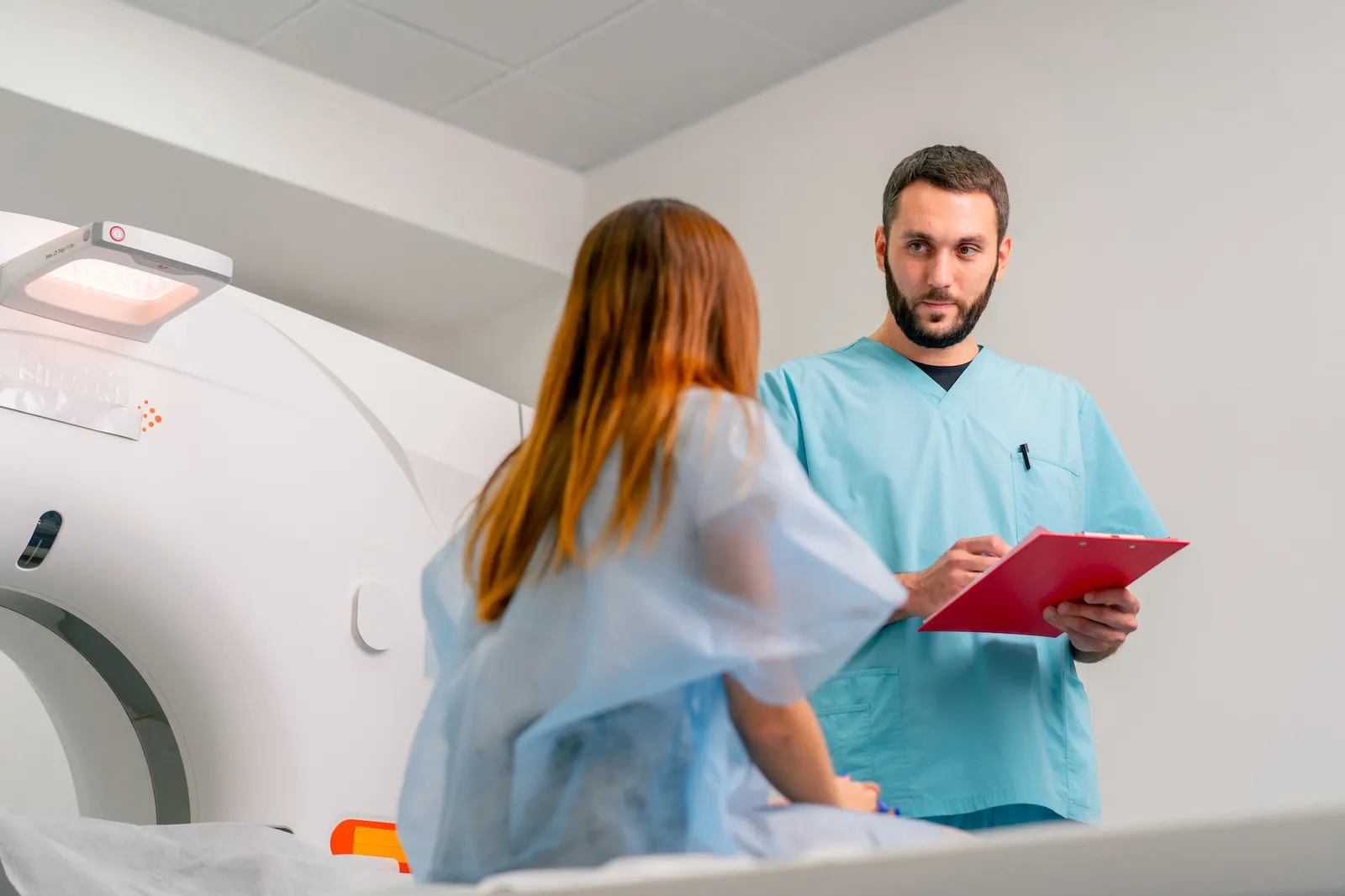
A nuclear stress test shows how well blood reaches your heart muscle at rest and under stress. It takes about 2 hours. Palatka is one of First Coast Cardiovascular Institute's five nuclear cardiology lab locations, so Putnam County patients can usually have it done in town.
FCCI's accredited nuclear lab performs over 3,000 stress tests a year, with board-certified technologists. Here is what to expect.
What the test looks for
Your heart muscle needs a steady supply of blood. When the heart's arteries are narrowed by coronary artery disease, some areas may not get enough, especially when the heart works harder. The test compares blood flow at rest and during stress to find those areas.
The results help your cardiologist find coronary heart disease, see how severe any past heart attack was, and judge the risk of future ones. They also help decide on next steps, such as medicines or a coronary angiogram in the cath lab.
How the test works
- A small amount of radioactive tracer goes in through an IV
- You get two injections: one at rest and one under stress
- Stress comes from walking on a treadmill, or from a medicine that acts like exercise if walking is hard for you
- A very sensitive gamma camera takes still pictures and movies of your heart
Areas with normal blood flow take up the tracer. Areas fed by blocked arteries show less. The images are shown in 3-D so your doctor can see how much of the heart is affected.
How to prepare
FCCI publishes a Nuclear Stress Test instruction sheet on its patient resources page, and your team will give you a copy. Follow it exactly. In general:
- Plan for about 2 hours
- Wear comfortable clothes and walking shoes
- Bring a list of your medicines
- Ask about any medicines, caffeine or food you should avoid beforehand
If anything on the sheet is unclear, call 386.325.2836 before your test day.
Other stress tests
Not everyone needs a nuclear test. A treadmill stress test takes about 30 minutes and uses an EKG while you walk. A MUGA scan takes about an hour and measures how well your heart pumps. FCCI also offers cardiac PET/CT and CCTA testing at some locations. Your provider will pick the test that fits your question.
Getting your results
Your FCCI provider will go over the results with you and explain what they mean. If something shows up, the next step may be medicine, more testing or a procedure. If the results are normal, that is useful too. Either way, you leave with a plan.
Questions to ask at your visit
Bring these questions to your nuclear stress test visit:
- Why is a nuclear test better for me than a treadmill test?
- Should I skip caffeine or any medicines first?
- Will I walk or get medicine for the stress part?
- How soon will I get results?
- What happens if the test is abnormal?
Care close to home in Palatka
Your nuclear test happens at the Palatka office, 205 Zeagler Drive, Suite 101, one of FCCI's five nuclear cardiology labs. Patients from Crescent City, Interlachen, San Mateo and East Palatka can usually test here without heading to Jacksonville.
FCCI has served Northeast Florida since 2002 and has more than 30 providers to read and follow up on your results. If your test leads to a hospital stay at HCA Florida Putnam Hospital, FCCI physicians cover there around the clock.
Unsure about caffeine, food or medicines before your test? Call 386.325.2836, weekdays 8 a.m. to 5 p.m. You can request a visit online too, but share health details by phone, not in the form.